Τρίτη 19 Δεκεμβρίου 2017

U.S.A.'s interesting latest news


A new National Security Strategy for a new era
Today at 2:00 p.m. ET, President Donald J. Trump will speak from the Ronald Reagan Building and International Trade Center in Washington to unveil the National Security Strategy (NSS) for his Administration.

The NSS is an important milestone for any presidency. A statutorily mandated document, it explains to the American people, U.S. allies and partners, and federal agencies how the President intends to put his national security vision into practice.

What to expect: President Trump’s strategy arrives less than a year after he takes office and builds on 11 months of Presidential action to restore respect for America abroad and renew confidence at home. Its four core themes will sound familiar, reflecting key tenets of the President’s major foreign policy addresses in Riyadh, Saudi Arabia; Warsaw, Poland; and the United Nations General Assembly Hall in New York.

Watch the President’s remarks here live at 2:00 p.m. ET.


The closing stretch for a major promise
When President Trump began his campaign, he promised that his Administration would push pro-growth economic policies that deliver financial relief to all Americans. With Congress’ release Friday of a conference report on the Tax Cuts and Jobs Act, the President is on the verge of honoring that commitment in a big way.

By lowering rates, simplifying America’s tax code, and repealing a failed tax on lower- and middle-income households known as the Obamacare individual mandate, the Tax Cuts and Jobs Act will grow our economy and boost wages.

The President applauds the House and Senate conferees on coming to an agreement and looks forward to giving Americans a tax cut before the end of the year.

Read the President’s closing argument for tax reform.
PHOTO OF THE DAY

President Donald J. Trump prepares to cut the “red tape” of regulations | December 14, 2017 (Official White House Photo by Shealah Craighead)
POTUS TODAY

This afternoon, President Trump will give remarks regarding the Administration’s National Security Strategy at the Ronald Reagan Building and International Trade Center.

Later in the day, the President will meet with Secretary of State Rex Tillerson.

========================

Bureau of Consumer Protection Business Center Blog Updates from the Federal Trade Commission

By Amanda Koulousias
There’s been a lot of talk about identity theft lately. Maybe you’ve even heard from customers affected by it. Your help can make a big difference. In fact, did you know that your business is required to provide identity theft victims with copies of records relating to the theft?
Read more >

FTC@100 Banner
After the Equifax data breach, some people are considering placing a fraud alert, freeze, or lock on their credit file to help prevent identity thieves from opening new accounts in their name.
To help consumers decide on a course of action, a Federal Trade Commission blog post, Fraud alert, freeze or lock after Equifax? FAQs, describes each option and how it works, how long it lasts, and how much it costs.
And to help business owners inform their customers, the FTC offers Fraud alert, freeze or lock after Equifax? Answers to questions people are asking you.
The Federal Trade Commission works to promote competition, and protect and educate consumers. You can learn more about consumer topics and file a consumer complaint online or by calling 1-877-FTC-HELP (382-4357). Like the FTC on Facebook, follow us on Twitter, read our blogs and subscribe to press releases for the latest FTC news and resources.
Contains new information on robocall complaints and a state-by-state complaint analysis
The Federal Trade Commission today issued the National Do Not Call Registry Data Book for Fiscal Year 2017. The FTC’s National Do Not Call Registry lets consumers choose not to receive most telemarketing calls.
Now in its ninth year of publication, the Data Book has been redesigned and contains a wealth of information about the Registry for FY 2017 (from October 1, 2016 to September 30, 2017). The Data Book now provides more information on robocall complaints, new information about the types of calls consumers reported to the FTC, and includes a complete state-by-state analysis.
In addition, this year the FTC has developed a mini site on its website to make the information in the FY 2017 Data Book more accessible for the public, such as providing a webpage for each state. For the first time, the data behind the report will be available in data files on the new website.
New in FY 2017
Highlights from this year’s Data Book include:
  • In reporting the total number of DNC complaints, the Data Book now breaks the number down to show how many were about robocalls versus live callers.
  • The Data Book now includes information about the topics of calls reported to the FTC that is gathered from the FTC’s online complaint form.
  • The Data Book now includes a state-by-state analysis of DNC complaints and uses a new, more accurate way of reporting consumers’ data. If consumers reported their state in their complaint, the Data Book includes their complaint in that state’s complaint data. If consumers did not report their state, the Data Book uses their area code to determine their state. The state-by-state analysis also includes the top 10 topics of consumer complaints.
  • The underlying data in the report is now publicly available at: www.ftc.gov/donotcall-databook2017.
FY 2017 Registration and Complaint Data
According to the Data Book, at the end of FY 2017, the Do Not Call Registry contained 229,816,164 actively registered phone numbers, up from 226,001,288 at the end of FY 2016. In addition, the number of consumer complaints about unwanted telemarketing calls increased from 5,340,234 during FY 2016 to 7,157,370 during FY 2017.
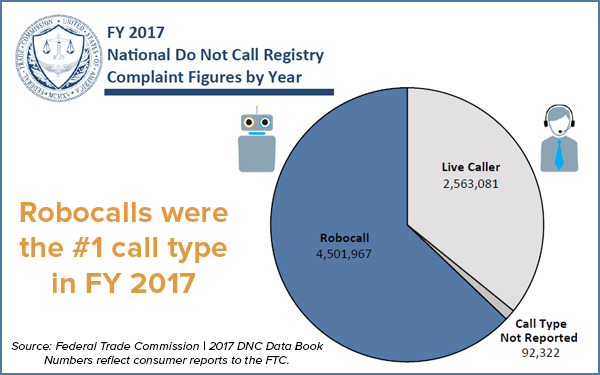
During the past fiscal year, the FTC has continued to receive many consumer complaints about telemarketing robocalls. In FY 2017, the Commission received 4,501,967 complaints about robocalls, compared with 3,401,614 FY 2016. For every month in the fiscal year, robocalls made up the majority of consumer complaints about Do Not Call violations. The topic of the call consumers most frequently identified when reporting a robocall complaint was “Reducing Debt,” with 771,158 complaints received in FY 2017.
Robocalls were the #1 call type in FY 2017 - Pie chart of Do Not Call complaints by Call Type in the current fiscal year. The largest portion is robocall at 4,501,967, followed by live caller at 2,563,081 and call type not reported at 92,322.
Information for Consumers
The Federal Trade Commission works to promote competition, and protect and educate consumers. You can learn more about consumer topics and file a consumer complaint online or by calling 1-877-FTC-HELP (382-4357). Like the FTC on Facebook, follow us on Twitter, read our blogs and subscribe to press releases for the latest FTC news and resources.

The Federal Trade Commission has closed the book on a scheme that tricked people into paying $25 to collect a $1 million prize they supposedly had won. Those who paid got nothing.
After weighing written arguments from the FTC and the defendants, a federal court issued a default judgment resolving FTC charges brought in September 2016, alleging that David Raff, Millenium Direct Incorporated, Ian Gamberg and Terry Somenzi mailed fake prize notifications to mostly elderly consumers that stated, after the recipient’s name, “ . . . this is NOT a preliminary or qualification letter of cash prize status; YOU HAVE WON A CASH PRIZE!”
In addition to sending many apparently unrelated prize mailings, the defendants sold consumers’ personal information to other schemes, causing many people to receive numerous deceptive cash prize notifications and other offers. Many consumers paid substantial sums of money in response to repeated mailings promising prizes.
Under the order announced today, Raff and Millenium Direct are required to pay$501,895, and they are banned from the prize promotion business and from misrepresenting any good or service. Gamberg was banned from misrepresenting any good or service under a settlement reached in February 2017. The case against Somenzi was dropped after he passed away last year.
The case is part of an international law enforcement initiative against mass-mail fraud. At the FTC’s request, the U.S. District Court for the Central District of California entered the default judgment against Raff and Millenium Direct on July 24, 2017.
The Federal Trade Commission works to promote competition, and protect and educate consumers. You can learn more about consumer topics and file a consumer complaint online or by calling 1-877-FTC-HELP (382-4357).  Like the FTC on Facebook, follow us on Twitter, read our blogs and subscribe to press releases for the latest FTC news and resources.

Δεν υπάρχουν σχόλια:

Δημοσίευση σχολίου